Prospec
A salesperson that works on its own. And knows when to stop.
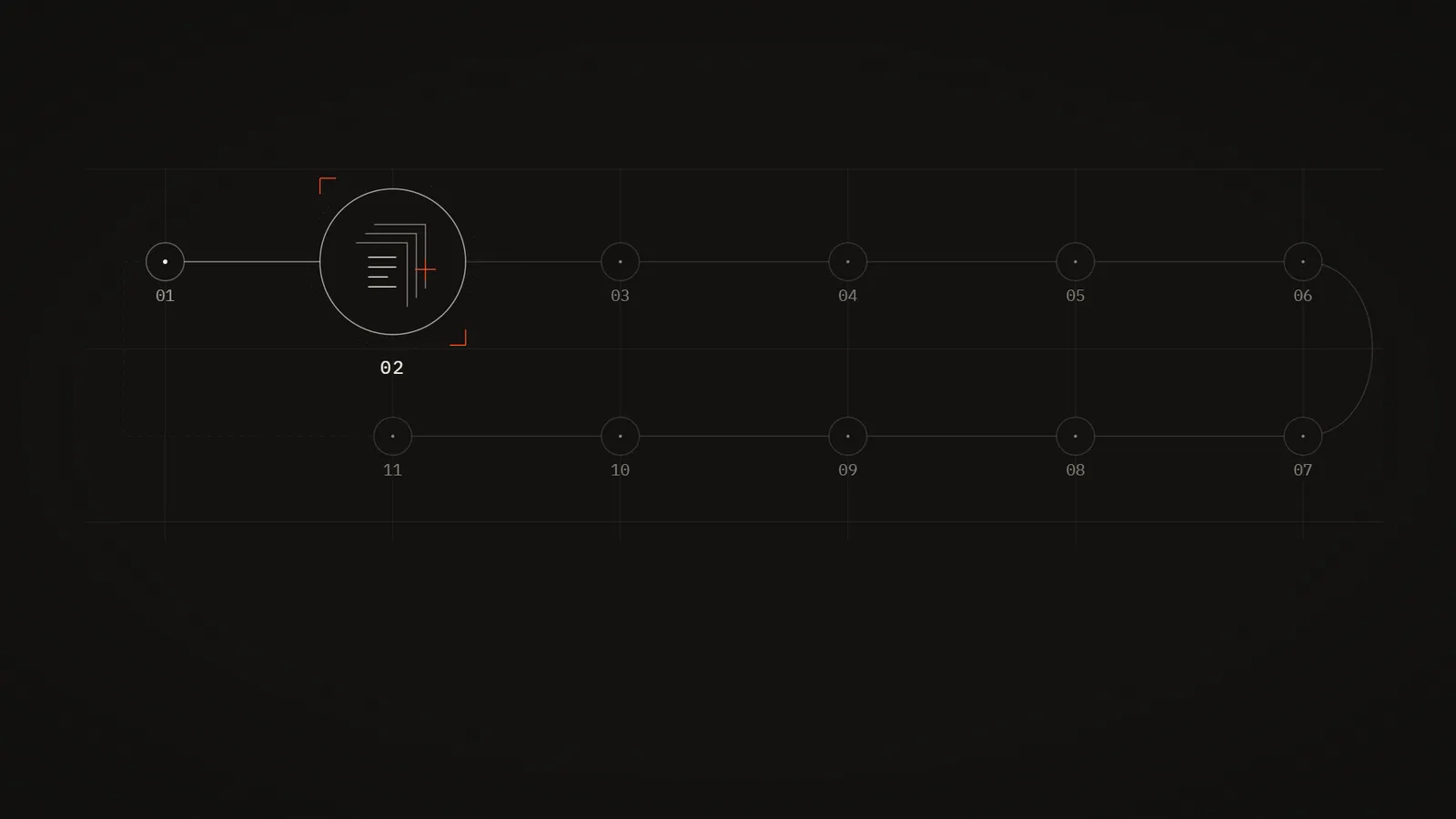
Prospec is Konict's salesperson, written in code. It sweeps the map and Google for businesses, reads each one's site, scores 13 criteria against quoted sources, writes a short letter reviewed by code and follows up on the reply, with nobody watching. What belongs to people stays with a person: negotiation, proposals and closing.
- Product, architecture and code
- Product · Applied AI · Automation · Full-stack
Context
Starting point
- Lead hunting done by hand, one at a time
- No record of what had already been said
- Follow-ups depended on someone remembering
- The costliest hour of the day spent before selling
Challenge
Cold outreach doesn't scale with people, and scales badly with machines that have no brakes.
Finding the business, checking the site, digging up the email, writing something that doesn't read like a template and remembering to follow up in three days is the costliest part of an agency's day. Automating it without brakes turns into spam, and spam burns the whole domain.
Research
- Eight niches with their own commercial playbook, from luxury cars to hospitality, plus a neutral profile.
- A separate playbook for Brazil: be found on Google in the city, lead to the business's WhatsApp, and the rules of the medical, dental and bar councils.
- A written client profile: an established business, plausible capacity, proven need, fitting size and a reachable decision maker.
Decisions
Qualification on evidence, not absence
- Having no website does not prove need, and a language model fills gaps with whatever sounds likely.
- 13 criteria, each tied to a passage quoted verbatim from a source; anything without a quote becomes unknown and leaves the sum.
- Fewer businesses get through, and the score varies between runs, which is why the tier decides, not the number.
- Tiers A+ to C, rejection only with proof, and a versioned scoring model.
Invented proof blocked in code
- An automated letter that cites a non-existent client, figure or result destroys trust at first contact.
- A code review before anything leaves: named clients, figures, results, testimonials, years of experience, faked intimacy and template praise fail the text; up to two rewrites, then it goes to the owner.
- Texts that would sound more persuasive get rejected.
- Positioning in the niche is allowed ("we help clinics to…"); proof, only when it exists.
The brakes come before the volume
- An automated SDR with no brakes becomes spam, and spam burns the whole domain.
- A warm-up from 8 to 35 emails a day, daily DM caps, a breaker that stops all email above 5% bounces in 7 days, and a tombstone against re-approach.
- On 1 Oct 2026 the breaker itself halted email, with 57 letters waiting in the queue.
- Wait rather than loosen it: protecting the agency's accounts comes first.
The AI never closes
- Negotiation, proposals and contracts are the decisions that cost most when wrong.
- A stage only moves with the message passage that proves it; sensitive, ambiguous and wrong-person replies go to the owner; won or lost only by a human decision, with a reason.
- More manual work at the edges of the conversation.
- Automation that never hands back the wheel is a trap.
The free quota as the ceiling
- The owner's decision: nothing paid, nothing that needs a card.
- Five models in three tiers, picked by task and priority; every attempt is counted before it goes out, and the sweep never eats the reserve kept for replies.
- With the quota low, the sweep assesses one business at a time.
- A lead who replied gets top priority, always.
Demonstration
EVERY 5 MIN
people close
Map
12 markets · 88 cities
Research
today's site
Qualify
13 quoted criteria
Letter
one idea · one question
Review
invented proof fails
Reply
15 categories
Person
only a human closes
No lead data appears in this case: the real dashboard shows real businesses and people, which is why Prospec is shown through diagram and film, not screenshots.
Implementation
- 65 API routes and 175 domain modules, on top of 31 applied database migrations.
- 41 automated test files with 253 cases; the migrations run against an in-memory Postgres.
- 88 commits between 19 Aug and 2 Oct 2026. Shipping to production is manual, on purpose.
What was built
- A dashboard with a nine-stage funnel
- A continuous sweep by city and niche, across 12 markets
- A dossier with numbered sources and an audit of each business's site
- A letter, a code review and up to two automatic follow-ups
- Instagram and Facebook DMs, with daily caps
- Reply classification into 15 categories and a learning engine
- A bridge that carries what was learned about a lead into the agency's project folder
Technology
- Next.js 15
- React 19
- TypeScript
- Tailwind CSS v4
- Framer Motion
- Google Gemini (5 models, 3 tiers)
- Structured output
- Tiered evidence
- Supabase (Postgres, Realtime, pg_cron)
- IMAP and SMTP
- Twilio
- OpenStreetMap
- Serper
- Vercel
- node:test and PGlite
- PageSpeed Insights API
Outcome
In operation. No contracts closed as of 2 Oct 2026; no replies to the first 26 contacts in the current funnel.
In operation, with no contract closed as of 2 Oct 2026. In the current funnel, no reply to the first 26 contacts. The learning engine answers "insufficient evidence" and recommends nothing.
733 · 89
businesses assessed and qualified in 24 hours
0 of 26
replies to first contacts in the current funnel, since 20 Sep
3 of 77
replies under the previous method; one interested, the same day, which did not become a contract
0
contracts closed
Learnings
- September and October rates are not comparable: the rules changed in between (tier A moved from 72 to 65, and the no-website track arrived).
- Preparing text at the right moment cuts waste: on one day, 84 texts were prepared for 12 sends.
- Counting each attempt before it goes out fixed a quota counter that read 346 when the real limit was 500.